
Display and Events: The Tatreez Forest Project
12 March '26 at 8:00 am - 24 March '26 at 9:30 pm
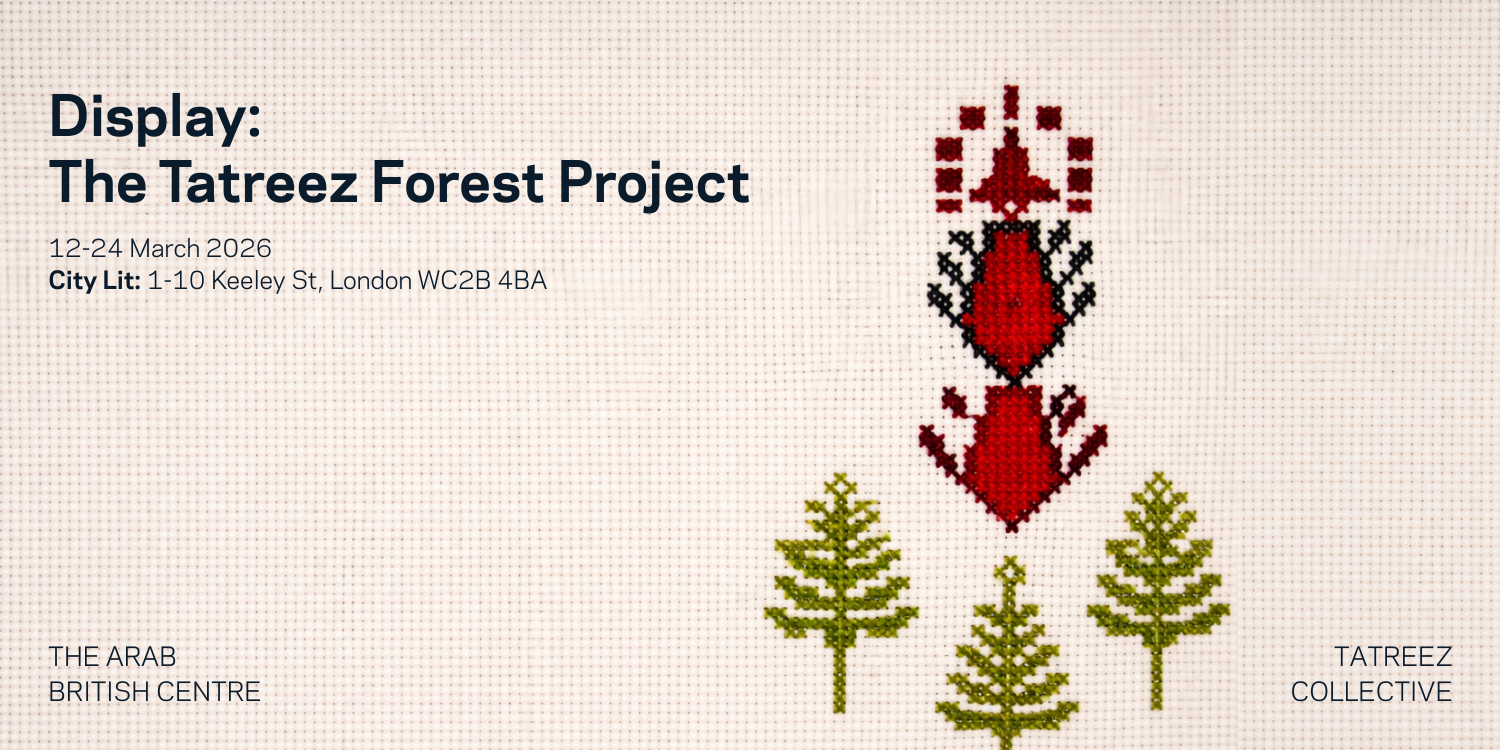
The Tatreez Forest: Stitching Palestinian Heritage is a community project co-developed by the Tatreez Collective and The Arab British Centre.
In 2024, we launched the project to bring Palestinian textiles closer to the public through active participation. Through workshops in museums across England and a downloadable stitching guide shared on social media, we invited people to explore historic collections of embroidered Palestinian garments and learn Tatreez for themselves. Participants stitched their own panels and contributed them to a growing collective artwork.
We set out to create a series of Tatreez cypress trees – a powerful symbol of hope and resilience in Palestinian culture. Each piece would bring together individually stitched patterns inspired by the museum collections we saw, including motifs of trees, birds, and vases. But as our digital call-out spread, individual stitchers and community groups also began contributing their own designs.
Within a year, over 400 panels arrived from 15 countries, representing thousands of hours of stitching and showcasing a kaleidoscope of patterns. The final tapestries, assembled by volunteers and on display here, showcase three cypress tree symbols which are attributed to Tatreez local to Hebron, a city in the West Bank, and Isdud, a Palestinian village which was ethnically cleansed in 1948. A short film documenting the project, an array of embroidered panels and a selection of letters from contributors are also exhibited.
The Tatreez Forest is more than a display of textiles. It is a living archive of community engagement, cultural preservation, and collective storytelling. Through this display, we invite audiences to experience Palestinian embroidery not only as heritage but as a contemporary act of connection and resistance.
The Tatreez Forest Project will be on display at City Lit from 12-24 March.
Acknowledgments
The Tatreez Forest project was supported by the Barakat Trust’s Hands on Islamic Art Grant, awarding funds from the National Lottery Heritage Fund.
Thank you to our partners at the Barakat Trust, City Lit, V&A South Kensington, Bristol Palestine Museum, the Whitworth Gallery in Manchester and Multaka at the Pitt Rivers Museum in Oxford.
Huge thank you to Manuela who led on assembling the trees; to all our wonderful volunteers and contributors; and to Jim Mangles for his work on the project film.
Finally, thank you to Tirazain.com, the amazing digital archive from where we drew the Tatreez patterns for this project.
Public Programme
Saturday 14 March
12–2pm ㅣ Tatreez Forest Contributor Meet-up
An informal gathering for contributors and Tatreez enthusiasts to meet and connect in the gallery space. No booking required.
3–5pm ㅣ Stitching Circle led by Najlaa Jarbou
A reflective stitching session inspired by the ancestral traditions of Palestinian embroidery. All materials provided. Limited capacity, book via Eventbrite.
Sunday 15 March
1:45-3:15pm ㅣ Screening of Stitching Palestine by Carol Mansour
A film centring the stories of Palestinian women and their connection to the land through embroidery. Book via Eventbrite.
3:30-5:30pm ㅣ Tatreez Collective Workshop: Personalise Your Own Clothing
A hands-on workshop where you will learn how to personalise your own clothing using tatreez. You’ll be introduced to the history and symbolism behind Palestinian motifs and guided through the technique needed to stitch onto fabric using the waste canvas method. Limited capacity, book via Eventbrite.
What is Tatreez?
Tatreez, the Arabic word for embroidery, is a centuries-old art form that holds deep cultural and historical significance in Palestine. More than just decorative stitching, Tatreez serves as a way of storytelling and preserving history, passed down through generations. The patterns and colours used in Tatreez vary across different regions, with each design telling its own unique story.
In cities like Ramallah, vibrant reds and geometric designs are common, while in Gaza, darker, earthy tones and floral motifs are often used. These regional differences reflect the local landscape and traditions.
Tatreez also speaks to day-to-day life and important social moments. Some patterns were traditionally stitched for weddings or to celebrate significant milestones like marriage and childbirth, while others were worn daily to indicate social status or community roles.
The colours and designs are not just artistic choices but symbols of personal identity, community, and connection to the land. In the face of decades of displacement and conflict, Tatreez has become a powerful symbol of resilience and resistance, with each stitch weaving together the collective memory, heritage, and strength of the Palestinian people.